
Theory of Change: The Surveillance Loop
The PIONEER Project applies an integrated and iterative surveillance loop to generate timely, actionable evidence for food safety decision‑making. The approach links data collection, laboratory analysis, data integration, and policy feedback to improve foodborne disease prevention and control.

Surveillance Sites
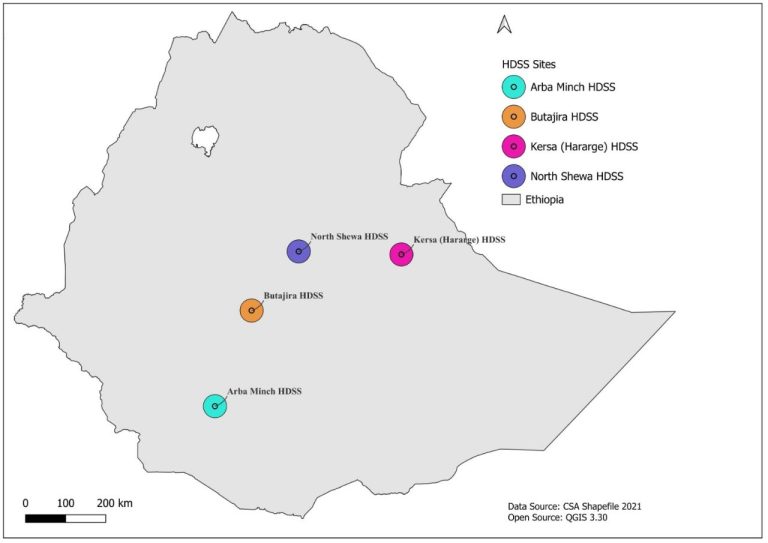
The PIONEER Project implements integrated sentinel foodborne disease surveillance at selected Health and Demographic Surveillance System (HDSS) sites across Ethiopia.

Arba Minch HDSS
📅 Established: 2009
👥 Population: ~63,000 individuals
🏠 Households: ~12,900 households
📍 Setting: 1 urban kebele and 8 rural kebeles
🌄 Ecology: Lowland and Midland
The Arba Minch HDSS, managed by Arba Minch University, provides longitudinal demographic and health surveillance across diverse ecological settings in southern Ethiopia. Its mix of urban and rural communities and regular follow‑up of vital events make it an important platform for studying foodborne disease exposure, transmission pathways, and environmental risk factors.

Hararghe HDSS
📅 Established: 2011
👥 Population: >320,000
🏠 Households: >60,000
📍 Setting: Urban, Semi‑urban & Rural
🌄 Ecology: Midland, and Highland
The Hararghe HDSS, operated by Haramaya University, is one of the largest demographic surveillance platforms in Africa, providing continuous monitoring of vital events, population dynamics, and health outcomes across eastern Ethiopia. Its diverse urban and rural populations make it a valuable platform for integrated foodborne disease surveillance and understanding environmental and social determinants of health.

Butajira HDSS
📅 Established: 1987
👥 Population: ~54,000 individuals
🏠 Households: ~12,800 households
📍 Setting: Predominantly Rural
🌄 Ecology: Lowland, Midland, and Highland
The Butajira HDSS, operated by Addis Ababa University, is among Ethiopia’s most established longitudinal surveillance systems, providing decades of demographic and health data. Its broad ecological variation and long-term population follow‑up make it a valuable platform for understanding foodborne disease risks, population health trends, and environmental influences on health outcomes.
North Shoa HDSS
📅 Established: 2023
👥 Population:
🏠 Households: >13,151
📍 Setting: Predominantly Rural
🌄 Ecology: Lowland, Midland, and Highland
The North Shewa HDSS, operated by Saint Paul’s Hospital Millennium Medical College, supports longitudinal health and demographic surveillance across diverse ecological settings in central Ethiopia. The site contributes to integrated data collection and public health research, strengthening foodborne disease surveillance and evidence‑based decision‑making.
Expected Outcomes
Co-created integrated sentinel foodborne disease surveillance system in Ethiopia.
Reliable estimates of foodborne disease burden and key risk factors.
Identification of priority pathogens, sources and contamination routes.
Evidence to support implementation of Ethiopia’s National Food Safety Master Plan (2025–2029).
Strengthened laboratory, analytic, and surveillance capacity.
Improved outbreak preparedness and food safety decision-making.
Project Approach
The PIONEER Project applies an integrated, stepwise approach combining stakeholder engagement, capacity strengthening, active surveillance, and laboratory analysis to generate robust evidence for foodborne disease surveillance and food safety decision‑making.
Stakeholder Engagement
Stakeholder meetings to co‑design the surveillance system, strengthen multisectoral collaboration, and support long‑term sustainability.
Capacity Building
Training of field staff, laboratory personnel, data collectors, and senior professionals to support integrated surveillance and analysis.
Active Surveillance
Implementation of active foodborne disease surveillance at health facilities and community levels within selected HDSS sites.
Sample Collection
Collection of food, stool, animal faeces, and water samples to support pathogen detection and exposure assessment.
Microbiological Analysis
Laboratory analysis using culture, multiplex PCR, metagenomics, and whole‑genome sequencing to identify foodborne pathogens.
Chemical Analysis
Assessment of chemical contaminants in food using laboratory methods and duplicate diet studies to understand exposure risks and support food safety management.
Data Analysis & Integration
Integration and analysis of surveillance, laboratory, and environmental data to identify foodborne disease patterns and support evidence‑based decision‑making.
Bioinformatic Analysis & Attribution
Application of bioinformatic and attribution methods to determine pathogen sources, transmission pathways, and the burden of foodborne diseases.